EXPLORE THE INCREDIBLE KARAKORAM HIGHWAY
DAY 1: Arrive at Islamabad
You will be met at Islamabad airport by your driver and guide and immediately transfer to your hotel in Islamabad. Once you are settled into your hotel, you will begin your full day of sightseeing of Islamabad and Rawalpindi.
We will begin in the old city of Rawalpindi with a visit to Raja (King) Bazaar. Amongst others, we pass through the silver and gold bazaars where we will see craftsmen working in traditional, time-honoured fashion.
We then head out from Rawalpindi to Islamabad, the modern capital city of Pakistan, along Murree Road, the main street linking the twin cities.
Quite apart from its inspiring, contemporary architecture, Islamabad is renowned for its open, green spaces: no less than 50% of the city’s 350 square miles is designated as protected park area. We drive up into the Margalla Hills to Daman-e-Koh (meaning ‘foot hills’) and gain a bird’s eye view right across the city.
Finally, we head back down to Shah Faisal Mosque, named after the late King Faisal I of Saudi Arabia. As the national mosque of Pakistan, it is the best know landmark in Islamabad, the sixth-largest mosque in the world and the largest within South Asia.
Overnight at hotel.
DAY 2: Fly from Islamabad to Gilgit
This morning, we fly from Islamabad to Gilgit.
Upon arrival in Gilgit, we check into our hotel, then spend the rest of the day exploring this historic tribal town and its environs. In ancient times it grew as an important bridging town and a crossroads on the Old Silk Road, acting as a natural hub for merchants travelling from as far away as China in the East and the Arabian Sea and Europe in the West.
We begin by heading out along the Gilgit river valley, then follow the old Gilgit road up the valley side to find the Kargah Buddha. This huge, imposing image of the Buddha, dating from the 7th century AD, is carved into a sheer rock face, still high above us.
We then return to Gilgit town to visit its bazaar and the old British cemetery in which the British explorer, George Hayward, is buried. If we are lucky, we might see a polo match at the Gilgit polo stadium while we are in town.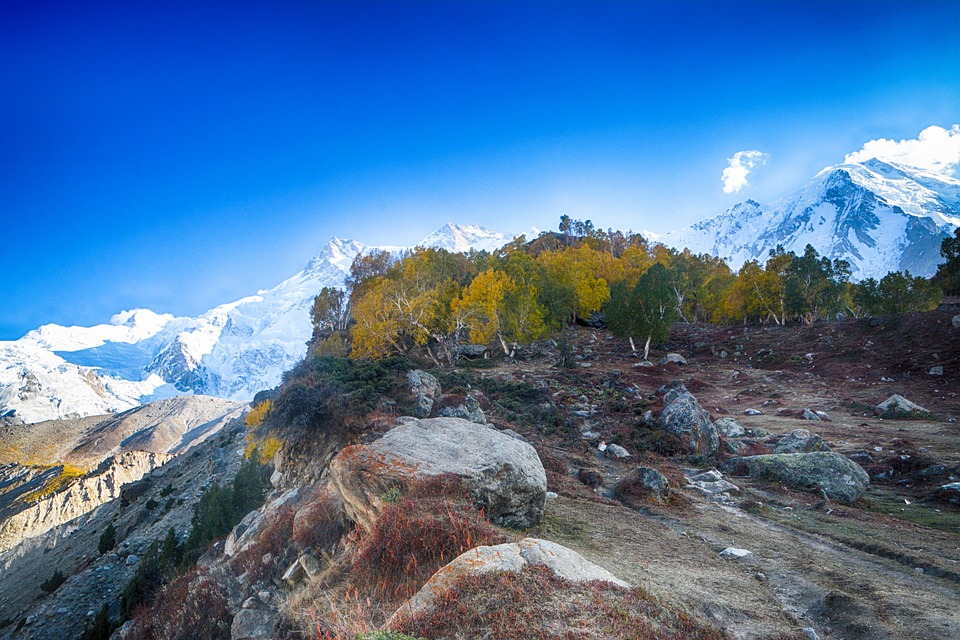
Overnight at hotel.
*Please note that if our flight is cancelled, we would need to complete the journey from Islamabad to Gilgit by road, requiring a very full day (12 hours). - 1 hour’s flight
DAY 3: Drive from Gilgit to Karimabad
Today we join the Karakorum Highway and head northwards along the Hunza valley, gaining fabulous views of Rakaposhi (7788m), towering over the valley sides, along the way.
The Hunza Valley increasingly resembles a fairytale land surrounded by beautiful rugged, snow-capped mountains. including Ultar Peak (7388m), Ladyfinger Peak (6000m), Diran (7266m) and, of course, Rakaposhi (7788m).
We arrive at Karimabad. Upon arrival, we settle into our hotel and then, before sunset, drive to the view point called Duikar for a panoramic view of the valley and watch the sun going down over the mountain tops. We return to Karimabad and overnight at hotel. (3 hours driving).
DAY 4: Today we enjoy a full day exploring Karimabad
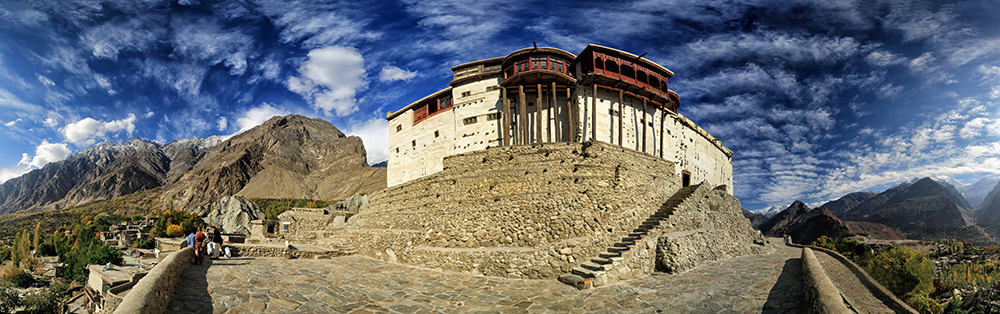
We begin by visiting Baltit Fort, the most significant built landmark in the region. Formerly the palace of the mirs of Hunza, its architecture reflects the strong links with Tibet at this time. Now about 700 years old, the fort remained continually inhabited until as recently as about 1960.
Baltit Fort stands magnificently upon an artificially flattened spur just below Ultar Glacier, while Ultar Peak, rising majestically directly behind it, provides a most wonderful and dramatic backdrop. From this position, strategically located with such a commanding view of the Hunza Valley, the mirs of Hunza were in perfect position to control the seasonal trans-Karakoram trade between South and Central Asia.
Next, we visit Altit Fort, itself a spectacularly situated on a cliff edge overlooking the Hunza river valley. Although its primary function was initially defensive, it also served as the seat of power of the Mir of Hunza and dates back about 900 years.
We then drop lower down the valley side towards the valley floor to find the 1000-year old village of Ganesh. Believed to be the oldest settlement in Hunza, we can still see its formidable ancient watchtowers and visit its richly carved traditional mosques.
In the evening, we take a stroll through the bazaar of Karimabad, stretched out all along its lanes which snake steeply uphill to Baltit Fort, and enjoy the richness of the local arts and crafts on display here. Overnight at hotel
DAY 5: Drive from Karimabad to Chapursan Valley via Khunjerab Pass
After breakfast, we continue our drive northwards along the Karakorum Highway, pausing at the beautiful, turquoise Attabad Lake, 21km long and 109m deep, which was suddenly and dramatically formed in January 2010 following a gigantic, tragic natural landslide.
Next, we briefly leave the KKH to visit the serene Borit Lake (2500m). Isolated from the main thoroughfare by lofty peaks, it was once the hunting ground of the mirs of Hunza, and still today remains an important sanctuary for migrating wildfowl.
We return to our vehicle, driving first through Passu, and below Passu Cones, and then past the beautiful Batura Glacier. Soon, we arrive at Sost, the Pakistani customs and immigration post.
Still we continue northwards, actually following the actual route of the Old Silk Road, on a memorable journey, next passing through Khunjerab National Park, towards the highest metalled road border crossing in the world. The higher we go, the more we should keep our eyes open for sightings of shy wild animals, including the Karakorum Ibex (markhors) and the Marco Polo sheep, as well as roaming yaks, as the landscape becomes ever-more remote and isolated.
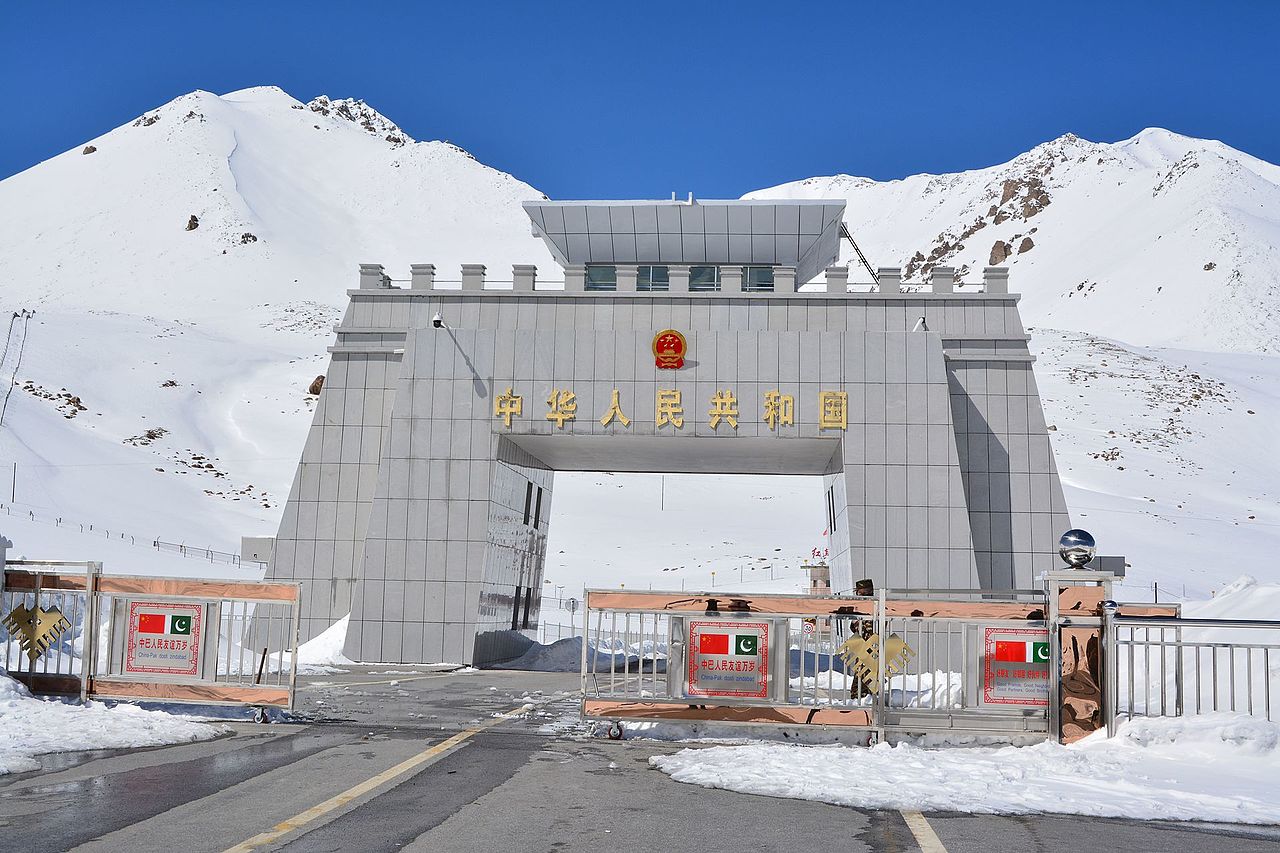
At the pass itself, which marks not only the international border between Pakistan and China but also the border between the Pamir and Karakorum mountain ranges, we can look over into China itself and, rather amusingly, find an ATM designated as the highest ATM in the world.
Unable to continue any further northwards, we now turn around and begin our return journey south. On this return journey, we soon leave the KKH and head up westwards along Chapursan Valley, passing through a series of traditional small villages before arriving at the attractive, dispersed village of Zudkhun where we spend the night. Overnight at guest house. (7 to 8 hours driving. 1 hour trekking).
DAY 6: Drive from Chapursan Valley to Passu via Babagundi Ziarat and Misgar
After breakfast, we leave Zudkhun and drive towards the head of Chapursan Valley. Here we find the pilgrimage site of Baba Ghundi Ziarat, the shrine of the Sufi saint who, according to legend, brought Islam to this valley. Although the saint himself is not buried here, his shrine remains a popular pilgrimage site.
The shrine is surrounded by green meadows which host herds of sheep and yaks in summer. Occasionally, from June to September, Kyrgyz traders arrive from Afghanistan. Traditionally crossing the Irshad Pass at the head of the Chapursan valley, they bring horses, yaks and sheep to trade with local villagers.
We return to Zudkhun and then drive back out of Chapursan Valley. We then follow the KKH briefly before leaving it once more to drive along the beautiful Kilik Valley.
We pass through the picturesque village of Misgar and arrive at Kalam Darchi Fort. Named after a naked saint, today occupied by the Pakistani army, this fort was built by the British during 1932-3 as part of their strategic defences to help keep the threat from Russia at bay.
The fort sits strategically at the fork near the head of the valley. While the westernmost fork leads to Mintaka Pass and the Wakhan Corridor in Afghanistan, the easternmost leads to Kilik Pass and China. Both were once important passes for traders working their way along the Old Silk Road.
We return by road to Passu and, in the evening, drive to a high-level vantage point which allows us to enjoy spectacular views of the justifiably-celebrated Passu Cones and to observe these mountain peaks being naturally illuminated by the shifting light of the setting sun.
Overnight at hotel. (7 hours driving).
DAY 7: Drive from Passu to Shimshal
We return to our vehicle and soon leave the Karakorum Highway once more, this time driving eastwards through a narrow and dramatic side valley to the remote village of Shimshal. The journey is surely one of the most spectacular in Pakistan, following a rugged jeep track which was created only as recently as 2003. Before this time, Shimshalis needed several days to walk from their villages just to reach as far as Passu.
In the afternoon we walk further along the banks of Shimshal River, passing through isolated houses, orchards and terraced fields, towards the head of the main valley where we gain enticing views of the Yazghil glacier.
We pause at the junction of the main valley with Zard-i-Gar Bin Valley. It is through this side valley that the villagers descend from their high summer grazing pastures, the ‘Shimshal Pamir’, at the end of their transhumance migration trek each October with their yaks, donkeys, sheep and goats.
Overnight at guest house. (3 hours driving. 2 hours walking).
DAY 8: Drive from Shimshal to Gilgit
In the morning, we spend some time exploring Shimshal village itself before driving back to the KKH, whereupon we continue our journey back south.
Just beyond Passu, we leave our vehicle to walk down to the banks of the Indus and reach the dramatic Hussaini Suspension Bridge, a footbridge which stretches right across the Indus to its far bank. Those who dare might choose to walk across the bridge over the Indus river to its far side and back again.
We rejoin the KKH and continue our journey to Gilgit.
Overnight at hotel. (6 hours driving).
DAY 9 : Drive from Gilgit to Fairy Point and then walk to Fairy Meadows
We travel briefly along the KKH as far as Raikot Bridge. Leaving the road at this point, we head onwards along a rough jeep track to Fairy Point where our walk begins.
From Fairy Point, we take a moderate walk to Fairy Meadows, set amongst pine forests, from where we enjoy spectacular views of Nanga Parbat’s north face and Raikhot Glacier and ice fall.
Overnight at huts on Fairy Meadows. (3 hours driving, 3 hours walking).
DAY 10: Walk from Fairy Meadows to Fairy Point, then drive via Lalusar Lake to Naran
We retrace our steps to Fairy Point and rejoin our vehicles. Once back on the KKH we continue our drive southwards before leaving this magnificent road for a final time, branching off along the Khagan Valley.
We cross Babusar Pass (4175m) and reach Lulusar Lake. This photogenic, 160km-long valley is set against forested peaks of the lesser Himalayan range and is one of Pakistan’s most popular summer holiday spots.
We then drive on to Naran, beautifully located at the point where the valley widens and the river quietens. It is an excellent location for fishing. Attractively surrounded by stone and boulder fields, Naran offers good views further down valley while picturesque tree-covered islands lie nearer at hand. We settle down for the night in Naran.
Overnight at hotel. (3 hours walking, 6 to 7 hours driving).
DAY 11: Drive from Naran to Rawalpindi
We continue our journey southwards, enjoying the mountain scenery for a final time, before arriving back on the plains of Pakistan and continuing to Rawalpindi.
Overnight at hotel. (6-7 hours driving).
DAY 12: Drive from Rawalpindi to Rohtas Fort* via Mankiala Stupa and return to Rawalpindi
After breakfast we drive out of Rawalpindi and pause at Mankiala Stupa. The stupa was built to commemorate the spot, where according to the Jataka tales, an incarnation of the Buddha called Prince Sattva sacrificed himself to feed seven hungry tiger cubs.
We continue to Rohtas Fort. This magical complex, one of the most imposing historical monuments in all Pakistan, was built in 1540 by Sher Shah Suri for the purposes of maintaining control over the local Ghakkar tribe. Situated strategically on the Grand Trunk Road, it originally housed 12,000 soldiers.
In the afternoon, we drive back to Rawalpindi.
Overnight at hotel. (5 hour round trip).
* Please note that temperatures between June and August on the plains of Pakistan can be very hot in which case alternative, local excursions will be organised.
DAY 13: Depart from Islamabad airport
Today is a free day up until your transfer back to Islamabad airport in good time for your departure flight.
End of services
