Kilimanjaro Lemosho Route – Detailed Trekking Guide & Itinerary
Longer, quiet approach

Longer, quiet approach
So you probably have a lot of questions, like "Is the Northern Circuit quiet? How difficult is the Northern Grand Traverse route," "When is the best time to climb Kilimanjaro" "Which route should I choose?" "Do I need insurance on Mount Kilimanjaro "What are the routes on Kilimanjaro and how do I choose one? "
The Lemosho Route 8 day Kilimanjaro trek is widely considered the optimal itinerary for climbers who want strong acclimatisation, excellent scenery, and a high summit success rate. By spreading altitude gain over eight days, this route allows your body to adapt gradually, significantly reducing the risk of altitude sickness while improving overall comfort on the mountain.
Compared to shorter itineraries, the 8-day Lemosho route provides additional time on the Shira Plateau and includes key acclimatisation hikes before summit night. For most trekkers, this balance of pacing and progression makes the 8-day Lemosho itinerary the preferred choice.
The Lemosho Route is often regarded as the best Kilimanjaro route for summit success due to its superior acclimatisation profile and longer duration. Unlike steeper or shorter routes, Lemosho approaches the mountain from the west and gradually ascends through diverse ecological zones, giving climbers more time to adapt to altitude.
Summit success rates on the Lemosho Route are among the highest on Kilimanjaro — particularly on 8- and 9-day itineraries — making it an excellent choice for first-time high-altitude trekkers and those who prioritise safety and success over speed.
A key advantage of the Lemosho Route is its well-designed Kilimanjaro acclimatisation schedule. The route includes natural “climb high, sleep low” opportunities, particularly on the Shira Plateau and during the approach to Lava Tower.
Our Lemosho itineraries are designed to:
* Gradually increase sleeping altitude
* Include acclimatisation hikes on key days
* Avoid rapid elevation gain
* Allow adequate rest before summit night
This structured acclimatisation schedule is a major reason why the Lemosho Route consistently outperforms shorter routes in terms of summit success and overall trek experience.
Being equatorial, Tanzania has two wet
seasons.
The first is the long rains from March to May, and then a short rainy season in
November. The daytime temperatures tend to range
around 32 to 38 degrees C in the forest, to anything from -2 to 6
degrees at the summit. Nights tend to range from 10 degrees down to well
below freezing. Summit temperatures can drop below -20C.
Distances trekked per day vary,
between 6km’s on day two, to close on 30km’s on the day of your summit,
dependent on which route you take.
The warmest months with the clearest trekking days on Kilimanjaro, are from mid to late December, January, February, September and
October. The rains often come in April and the start of May with the
possibility of some snow. June through to August are superb trekking
months, though evening temperatures tend to be colder. The wettest
months on Kilimanjaro are
November and early December, where snowfalls are likely. Note, that as
this is a mountain it is not impossible to get sporadic snow or rainfall
at odd times throughout the year, although the snow normally only falls
above 4800m.
As part of your Kilimanjaro Park Fee, emergency evacuation services
are included. This means that you will be carried down to the base of
the mountain as quickly as possible, on a mountain stretcher. In many
cases, a foot evacuation is quicker than waiting for insurance cover to
arrange the logistics for a helicopter.
There
are helicopter evacuation points on all of the major routes at specific
locations, namely Horombo, Barranco, Barafu, Kosovo, Stella, Millennium
and Shira. All points are within less than five hours from the crater
by stretcher and SAR emergency medical service can be deployed within 5
minutes from Kilimanjaro or Meru, regardless of the season.
Of course, nothing is free and deployment of this service is
contingent on you already have an insurance covers for evacuations to
6,000 meters above sea level.
So lets start with the worst problem of all; human waste. It
is something we all need to do at some point of the day and there are purpose
built toilets at each camp and at some places along the route. If you are on Marangu
you will find nice flush toilets but for the rest of the mountain they are long
drops. Lower down the mountain in the forest zone and at the first camps, the
toilets smell due to low altitude and warm weather during the day. The effect
of this is that many people elect to go outside the toilet in the surrounding
area, resulting in unwanted piles of human waste and toilet paper littering the
area. The situation at Crater camp at 5700m is even more dire, where they are
no custom toilets meaning that the only places to go are in and around crater
camp itself. Due to the sub zero temperatures, nothing freezes. Between camps,
there are few, if any toilet facilities.
For the reasons mentioned above, regardless of how dire the
conditions are in the toilet we ask that climbers make use of them. They are there for good reason. Take vicks and
rub it under your nose if you must. If
not, hire a toilet tent where the waste can be properly disposed of. And if you
really do need to go between camps, find yourself a “loo with a view” a good
20m off the trail and away from any streams, dig and hole and bury your
deposit.
Everything that is carried up the mountain that is not consumed must be brought back down again. At every camp, the gear that the porters carry must be weighed on leaving each camp and again on arriving to the next one. KINAPA enforces strict regulations to keep Kilimanjaro clean. Licenses are easily revoked or heavy fines imposed if it is found that a guide is leaving litter on the mountain. So in theory, all you have to do is give your little paper bag to the kitchen team to be carried off the mountain or better still, leave it in a bag in your duffel and dispose of it when home. Why paper bag? Simple, plastic is a global curse and as of 1 June, Tanzania has banned the use of plastic bags. Anyone arriving into Tanzania will have to “surrender” plastic bags in their possession before entering the country. En route to summit, sucking on glucose sweet helps with thirst and a dry mouth but sadly, most of those sweet wrappers find there way to the scree paths. If you have the energy to dig out a sweet and open it, then you have the energy to put the wrapper back in your pocket. The same applies to hand warmers and dead camera batteries.
The cost of a medical evacuation from the mountain is expensive, which is why adequate travel insurance is required on all climbs booked through us. Adequate, means you must be covered for
1) Trekking or hiking – this may sound strange, but many insurance list that as an exclusion.
2) Altitude up to 6,000 meters. Most travel insurance providers do
not include this under their standard cover and often limit it to 3500m
or less.
3) Sprains strains and physiotherapy – yes, many insurers exclude
this; though ironically, this is what you will most likely need cover
for.
4) Personal accident – this is the horrible part of insurance. Yes,
you need to be covered in the case of death. We are often told by
clients – “if anything happens to me, just leave me there.” It is not
that simple.
LEMOSHO ROUTE ITINERARY
Day 1: Arrival at Kilimanjaro International Airport – Transfer to Hotel
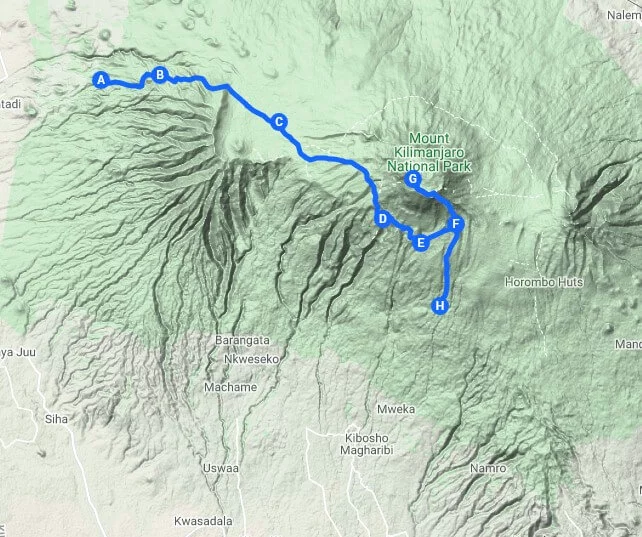
Arrive at Kilimanjaro International Airport (JRO) where our team will meet you and transfer you to your hotel in Moshi, the gateway to Mount Kilimanjaro trekking. Rest and prepare for your Lemosho Route climb starting the next day.
Day-2: Lemosho Glades (2200m) to Mkubwa Camp (2750m)
Elevation: 2200 metres to 2750 metres
Distance: 6 kilometres
Trekking duration: 3 hours to 4 hours
Environment: Montane forest
This morning we stop briefly in Moshi and then drive about 5 hours to Londorossi Park Gate at 2200m . After completing park formalities for Lemosho Route, we drive for another 11km to Lemosho Glades at 2000m. From here, we trek about 3 hours to Mkubwa, our camp.
Day-3: Mkubwa Camp to Shira Camp 1 (3500m)
Elevation: 2750 metres up to 3500 metres
Distance: 8 kilometres
Trek time: 5 to 6 hours
Environment: Moorland
After breaking camp, we hike to Shira Camp 1 located near a stream. We hike through moorland shrub taking in views of Mt Meru and this afternoon we have the chance to film incredible sunsets.
Day-4: Shira Camp 1(3500m) to Shira Camp 2 (3840m)
Elevation: 3500 metres to 3840m metres
Distance: 6 kilometres
Trek duration: 2 to 3 hours
Environment: Moorland
Environment: Moorland The route is relatively easy trek across the plateau that leads to Shira Camp 2 on moorland meadow. A variety of walks are available on the plateau making this excellent for acclimatisation to the gains in altitude. Shira is one of the three volcanoes on the Kilimanjaro massif.
Day-5: Shira (3840m)- Lava Tower (4630m)-Barranco (3950m)
Elevation: 3840 metres up to 4630 metres then down to 3950 metres
Distance: 10 km
Hiking Time: 6 hours - 8 hours
Habitat: Alpine Desert
After breakfast, you hike though the moorland scrub and enter into a moonscape of semi-alpine desert, while you hike constantly upwards toward Lava Tower. As you approach an altitude of 4200m, you may start to feel a shortness of breath as the effects of altitude take hold. After Lava Tower, you trek into a beautiful valley to Barranco camp where you spend the night at a lower altitude than Lava Tower. Today follows the golden principle of climb high and sleep low on Lemo sho Route.
Day-5: Baranco Huts (3985m) to Barafu (4550m)
Elevation: 3985 metres - 4680metres Distance: 13km Trek: 7 to 9 hours Environment: Alpine Desert
Begin with a scramble up the famed Barranco Wall. After admiring views of Heim Glacier, continue across three ridges and valleys to Karanga Valley. After a short break, continue your climb to the high-altitude Barafu Camp, your base for the Kilimanjaro summit attempt. Rest early — tomorrow is summit day.
Day-7: Barafu (4550m)- Uhuru Peak (5895m)-Mweka (3100m)
Elevation: 4600 metres to 3100 metres
Highest point: 5895 metres (Uhuru Peak)
Distance: 30 kilometres (7 kilometres ascent, 13 kilometres descent)
Trek duration: 13 to 16 hours (6 - 8 hours ascent, 7 - 8 hours descent)
Environment: Stone scree / ice-capped summit
Your Kilimanjaro summit climb begins at midnight. Ascend through volcanic scree toward Stella Point (5,685m) on the Kibo Crater Rim. From there, it’s another 1–2 hours to Uhuru Peak (5,895m) — the highest point in Africa.
After celebrating your summit, descend to Barafu for a short break before continuing down to Mweka Camp. This is the most challenging and rewarding day of your trek.
Day-8: Mweka camp (3100m)- Mweka (1980m)
Elevation: 3100 metres to 1800 metres
Distance: 8kilometres
Trek duration: 3-4 Hours
Environment: Montane Forest
A short descent through the lush forest brings you to Mweka Gate, where your Kilimanjaro trekking adventure ends. Those who reached Stella Point receive a green certificate, and those who summited Uhuru Peak are awarded a gold certificate.
Day-9: Depart Transfer to Kilimanjaro International Airport for your return flight. Depart with unforgettable memories of your successful Lemosho Route climb on Kilimanjaro.
End of services
An accredited Kilimanjaro guide is a mountain guide who is officially authorized and certified to lead climbs on Mount Kilimanjaro.
In plain terms, it means:
✅ They’re licensed by the Tanzanian authorities (through organizations like TANAPA – Tanzania National Parks).
🧭 They’ve completed required training in areas like mountain safety, first aid, rescue procedures, and environmental protection.
🪪 They carry an official guide ID/badge that park rangers can check at entry gates.
🏔️ They’re legally allowed to guide climbers—no accreditation = no guiding on Kili.
Why it matters for you:
Safety: Accredited guides know altitude sickness signs, evacuation routes, and emergency protocols.
Legality: Kilimanjaro cannot be climbed without a registered guide—it’s mandatory.
Ethics: Accredited operators are more likely to follow porter welfare rules and fair labor standards.
Experience: They understand routes, weather patterns, pacing, and acclimatization strategies.
Take a moment to read our blog about the porters on Kilimanjaro


The Lemosho Route on Mount Kilimanjaro is considered moderate to challenging, making it one of the best Kilimanjaro routes for acclimatization and summit success. While it is not technical or dangerous, the difficulty comes from high altitude, long hiking days, and changing weather conditions.
Altitude: The biggest challenge is altitude sickness, especially above 4,000 meters as you approach Uhuru Peak (5,895 m)
Distance: The Lemosho Route is longer than other routes (typically 7–8 days), which helps acclimatization but requires good endurance
Daily Hiking Time: Expect 5–8 hours of trekking per day, with summit night lasting 10–14 hours
Terrain: Includes rainforest trails, alpine desert, rocky paths, and volcanic scree
Weather: Temperatures range from hot and humid to freezing cold, especially on summit night
Yes — the Lemosho Route is one of the best Kilimanjaro routes for first-time climbers who are reasonably fit. Its gradual ascent profile and excellent acclimatization schedule give it one of the highest summit success rates on Mount Kilimanjaro.
The cost of a 7 day Lemosho Trek varies depending on group size, season, inclusions, and domestic flights. On average, trekkers can expect prices $2,545 for a single climber to around $2100 per person for a group of 6-10 people. For an 8 day trek, around $2550 to $2070 per person sharing
These fees are mandatory for every climber and are set by TANAPA — you cannot climb Kilimanjaro without them, and your tour operator must pay them before you enter the park.
✔ Conservation fee: $70 per person per day that you spend inside the park.
✔ Camping fee: $50 per person per night on camping routes like Machame.
✔ Rescue fee: $20 per person per climb (one-time charge).
✔ Crew entrance fees (guides/porters/cooks): Tanzanian park charges for support crew are nominal — around 5000 TZS (~$2) per crew member per climb.
✔ VAT (Value Added Tax): 18% VAT is added to most of these park fees.
Park fees alone on a 7-day Machame climb usually total around $900–$1,000+ per person
Guide, Porters & Crew Services
On top of these costs, the following is then added for paying wages and managing staffing:
Note: Prices may vary depending on customisation. Contact us for a detailed quotation based on your preferred travel dates and group size. What we do not do, is charge you for having your own private group. Whether you join a fix departure or choose to trek in private, our costs remain the same.
No. Kilimanjaro is a trekking peak in that you essentially hike or trek to summit. No technical expertise is required, nor use of rope etc. There are sections on the mountain which require a scramble up rocky areas, dependant on which trekking path you follow.
The shortest number of days required is 7, but by the time you have added on arrival and departure days it is 9. As a longer approach route it is best done over 8 or 9 days to increase your chances of success.
Lemosho route is approximately 70 km /42 miles from gate to gate so a good 8km longer than e.g. Machame or Whiskey route. The distances each day will vary e.g. on day one the distance is 3.7 miles or6km. The elevation gain is 500m/ 1,640 feet. On the summit climb to Uhuru Peak as a contrast you will hike around 12 miles/ 21km
On Lemosho trek you stay overnight in two person tents
There are several streams on the trail and porters will collect water from them. The cook then boils this water for you to fill you water bottles for your days hike. You can also use purifier tablets in stream water or add it to your boiled water however it can also have an effect on the diamox and make you feel nauseous. The higher you climb the less water there is. On the Machame trail, for example, the last water point is at the Karanga Valley, the lunch-stop before Barafu; on Marangu, it’s just before the Saddle. For this reason it is essential that you carry enough bottles for at least two litres.
Although Kilimanjaro is classified as a ' trek,' it has a very fast altitude gain. Climbing Mount Kilimanjaro requires physical fitness training and stamina and most importantly, mental fitness training. Your legs will get you up the first 4-5 days but for your summit night, mental strength will get you to the top - (assuming of course that you are not affected by altitude, sickness or pure fatigue). A good exercise and training program is essential. The climb should not be undertaken lightly, after all, why spend the money if you are not willing to prepare yourself physically as well?
This really depends on the operator you travel through. The parks Kilimanjaro Park authorities do not ask for any medical information on the climbers when permits are purchased. Some operators request the clients complete a medical form, others do not. We require that all of our clients complete a medical form and based on the answers, we may request a letter from your medical practitioner. People suffering with conditions such as severe asthma e.g. should not climb. Regardless, anyone attempting the climb, or any climb for that matter, should ensure that they are medically fit, and convey any medical conditions to the operator they book with.
This is one of the most often asked questions - "how will I cope with the altitude". To be honest, this is an ' unknown' factor as no-one can predict how your body will cope at altitude. People who have been to altitude many times in the past without problems, may on one climb suddenly develop problems. There are many factors that play a role. The only way to help combat this, is to take all of the necessary precautions, and walk slowly, pole pole. Choosing a path like Machame where you get to follow the principle of "climb high, sleep low" is also advisable.
There are certain essentials that are needed for most climbs and Kilimanjaro is no different. The best way to draw up your list is from the base up, i.e. thermal underwear, then hands and feet (gloves, socks etc). Then boots which must be waterproof with good ankle support, trekking pants, trekking tops, short and long sleeve, thermal jacket, outer shell jacket which likewise is windproof and water proof, hat, scarf, beanie, balaclava. Then consider sleeping, i.e. sleeping bag, mat etc. Most companies supply sleeping mats so check before you buy one. Then, the last items to add are personal items like toiletries, camera, medicines, water bottle, backpack, camera etc.
Most companies will supply you with a comprehensive list for your trek, as do we. If you arrive to Kilimanjaro and are missing items, you can normally rent most gear. Do not, however, reply on buying your gear on arrival.
Unfortunately this is something every trekker has to consider. Anything from a stomach bug to altitude sickness can quickly stop a trekker in their tracks. If you are ill and need to turn back or even too tired to continue, a porter will walk off the mountain with you and your gear. If you are too sick to walk, then part of your fee includes evacuation by teams already on the mountain and employed by the Parks authorities.
Yes you do. We (Nomadic Adventures) do not allow anyone to climb with us unless they have adequate travel insurance. Adequate, means you must be covered for
1) trekking or hiking - this may sound strange, but many insurance list that as an exclusion.
2) altitude up to 6,000 meters. Most travel insurance providers do not include this under their standard option and often limit it to 3500m or less.
3) Sprains strains and physiotherapy - yes, many insurers exclude this, though ironically, this is what you will most likely need cover for.
4) personal accident - this is the horrible part of insurance. Yes, you need to be covered in the case of death. We are often told by clients - "if anything happens to me, just leave me there." Bodies need to be brought home or laid to rest overseas, and this can run into thousands of dollars, creating a huge burden on family members.
We will assist in helping you provide good cover. If you need cover or simply a quote, follow the details herewith:. Once you have done your initial quote, you will need to upgrade your cover to include altitudes up to 6000m. Towards the bottom of the page you will see a section called, Options: Upgrade your cover. Click the link called 'View Adventure Sports Benefits'. A blue pop up screen will open. Look for the level of cover required for 'trekking to 6,000 meters' or 'hiking to 6,000 meters'. Depending on your country it is usually a level 1 or 2. Note: we are not insurance experts and it's your responsibility to ensure you have correct and adequate cover. If you live in South Africa, we have other cover options
There are 7 summit routes; namely, Marangu, Rongai, Lemosho, Shira, Umbwe and Machame. Of all, Machame is by far the most scenic albeit steeper path up the mountain. The Rongai is the easiest camping route and the Marangu is also easier but accommodation is in huts. As a result, it tends to be very busy and ascent and descent are the same. Both of the latter have lower prospects to acclimatise by the climb high sleep low principle unless one adds on extra days. The Northern Circuit, approaches Kibo volcano from the west, crossing the caldera of Shira Volcano before turning north to follow the trail through Moir Valley and around the northern side of Kilimanjaro. For a quick overview we have a quick reference panel on the right of the screen. For a detailed look, click onto Kilimanjaro Trekking Routes.
The Kilimanjaro National Park fees are something that nobody can escape and are a large portion of your climb cost.. For a six day/five night camping trek you pay about $800 in fees alone! So on average a climb will cost you between $1450 and $2800 depending on the number of days, number of people and the route that you take. There are some operators who will quote you $1000 for a trek - ask yourself, what are they skimping on and who is going to suffer as a result. You? Your safety? The porters?
There are so many good books written on Kilimanjaro. Some of the ones we suggest are:-
1) Kilimanjaro: The Trekking Guide to Africa' s Highest Mountain by Henry Stedman
2) The Snows of Kilimanjaro by Ernest Hemingway is a short story about a writer who is on safari in Tanzania
3) Kilimanjaro: To the Roof of Africa by Audrey Salkeld.
A link to Mount Kilimanjaro National Park website
Kilimanjaro National Park -UNESCO World Heritage Centre
Acute mountain sickness: MedlinePlus Medical Encyclopedia
Those who have climbed Mount Kilimanjaro know that the porters are the heart and soul of your trek. Without their hard work and strength we would not be able to fully experience the magnificence of Kilimanjaro. A link to the Kilimanjaro Porters Assistance Project
We arrange treks from just 1 person on their own with a guide and porters to large groups. If you climb alone you will still get to meet other people on the mountain if you are sociable.
🌕 Kilimanjaro Full Moons in 2026
January 3, 2026 – Wolf Moon
February 1, 2026 – Snow Moon
March 3, 2026 – Worm Moon
April 1, 2026 – Pink Moon
May 1, 2026 – Flower Moon
May 31, 2026 – Blue Moon
June 29, 2026 – Strawberry Moon
July 29, 2026 – Buck Moon
August 28, 2026 – Sturgeon Moon
September 26, 2026 – Harvest Moon
October 26, 2026 – Hunter’s Moon
November 24, 2026 – Beaver Moon
December 23, 2026 – Cold Moon
January 22, 2027 – Wolf Moon
February 20, 2027 – Snow Moon
March 22, 2027 – Worm Moon
April 20, 2027 – Pink Moon
May 20, 2027 – Flower Moon
June 18, 2027 – Strawberry Moon
July 18, 2027 – Buck Moon
August 17, 2027 – Sturgeon Moon
September 15, 2027 – Harvest Moon
October 15, 2027 – Hunter’s Moon
November 12, 2027 – Beaver Moon
December 11, 2027 – Cold Moon
The BarrancoWall is one of the most famous landmarks on Mount Kilimanjaro, encountered by trekkers on the Machame Route and Lemosho Route. Rising steeply above the Barranco Valley, the wall is known for its dramatic appearance, hands-on scrambling, and unforgettable views. But beyond the climb itself, the Barranco Wall tells a much older geological story.
Mount Kilimanjaro is a stratovolcano, formed through repeated volcanic eruptions over hundreds of thousands of years. The rock that makes up the Barranco Wall originated as lava flows and volcanic deposits, which cooled and hardened as the mountain grew. These layers created the foundation of the wall long before humans ever set foot on the slopes.
As Kilimanjaro’s massive volcanic structure aged, parts of the cone became unstable. Large sections collapsed under their own weight, causing landslides and leaving behind steep, exposed rock faces. The Barranco Wall is the visible edge of one such collapse—essentially a scar left by the mountain’s shifting structure. After the collapse, erosion shaped the Barranco Wall into its present form. Rainfall, gravity, and freeze–thaw cycles gradually removed softer rock while leaving behind stronger volcanic material. Over thousands of years, this process sharpened the wall’s vertical profile and carved the natural ledges used by climbers today.
The wall, often called the Breakfast Wall because it is climbed straight after breakfast, rises approximately 250–300 meters (800–1,000 feet) above the Barranco Valley, creating a striking visual contrast against the surrounding alpine landscape. Deep fractures and vertical lines in the rock add to its dramatic appearance while also providing natural climbing routes. From below, the wall appears intimidating; from above, it reveals sweeping views across Kilimanjaro’s southern slopes.
Is it a “wall” – well no it is not, in the sense that a wall is pretty much vertical which Barranco is not. It consists of a rocky path that zig zags up the rock section of the mountain. Yes it is steep, let us not deny that fact, but do-able? Definitely! While physically demanding, it requires no technical climbing skills and is entirely achievable for most trekkers with a head for heights. It is often considered one of the most enjoyable and memorable sections of a Kilimanjaro trek.
The Kissing Rock is a well-known landmark on Mount Kilimanjaro, located on the Barranco Wall along the Machame and Lemosho routes. It’s a narrow rock passage where climbers must press close to the rock face—often leaning in so closely that it looks like they are “kissing” the mountain. This is how the feature got its name.
The Kissing Rock is about three-quarters of the way up the Barranco Wall, at an altitude of roughly 4,200 meters (13,800 ft). It marks one of the most memorable moments of the climb, both visually and mentally.
The Barranco Wall is more than just an obstacle on the trail—it is a visible record of Kilimanjaro’s volcanic past, shaped by collapse and erosion over immense time. Each step across its ledges is a walk through the mountain’s geological history, making the climb both physically engaging and deeply connected to the forces that formed Africa’s highest peak.
The Barranco wall is along the Machame Route, Shira Route, Lemosho Route and Umbwe Route.
Kilimanjaro Frequently Asked Questions
No. Kilimanjaro is a trekking peak in that you essentially hike or trek to summit. No technical expertise is required, nor use of rope etc. There are sections on the mountain which require a scramble up rocky areas, dependant on which trekking path you follow.
The shortest number of days required is 7, but by the time you have added on arrival and departure days it is 9. As a longer approach route it is best done over 8 or 9 days to increase your chances of success.
Lemosho route is approximately 70 km /42 miles from gate to gate so a good 8km longer than e.g. Machame or Whiskey route. The distances each day will vary e.g. on day one the distance is 3.7 miles or6km. The elevation gain is 500m/ 1,640 feet. On the summit climb to Uhuru Peak as a contrast you will hike around 12 miles/ 21km
On Lemosho trek you stay overnight in two person tents
There are several streams on the trail and porters will collect water from them. The cook then boils this water for you to fill you water bottles for your days hike. You can also use purifier tablets in stream water or add it to your boiled water however it can also have an effect on the diamox and make you feel nauseous. The higher you climb the less water there is. On the Machame trail, for example, the last water point is at the Karanga Valley, the lunch-stop before Barafu; on Marangu, it’s just before the Saddle. For this reason it is essential that you carry enough bottles for at least two litres.
Although Kilimanjaro is classified as a ' trek,' it has a very fast altitude gain. Climbing Mount Kilimanjaro requires physical fitness training and stamina and most importantly, mental fitness training. Your legs will get you up the first 4-5 days but for your summit night, mental strength will get you to the top - (assuming of course that you are not affected by altitude, sickness or pure fatigue). A good exercise and training program is essential. The climb should not be undertaken lightly, after all, why spend the money if you are not willing to prepare yourself physically as well?
This really depends on the operator you travel through. The parks Kilimanjaro Park authorities do not ask for any medical information on the climbers when permits are purchased. Some operators request the clients complete a medical form, others do not. We require that all of our clients complete a medical form and based on the answers, we may request a letter from your medical practitioner. People suffering with conditions such as severe asthma e.g. should not climb. Regardless, anyone attempting the climb, or any climb for that matter, should ensure that they are medically fit, and convey any medical conditions to the operator they book with.
This is one of the most often asked questions - "how will I cope with the altitude". To be honest, this is an ' unknown' factor as no-one can predict how your body will cope at altitude. People who have been to altitude many times in the past without problems, may on one climb suddenly develop problems. There are many factors that play a role. The only way to help combat this, is to take all of the necessary precautions, and walk slowly, pole pole. Choosing a path like Machame where you get to follow the principle of "climb high, sleep low" is also advisable.
There are certain essentials that are needed for most climbs and Kilimanjaro is no different. The best way to draw up your list is from the base up, i.e. thermal underwear, then hands and feet (gloves, socks etc). Then boots which must be waterproof with good ankle support, trekking pants, trekking tops, short and long sleeve, thermal jacket, outer shell jacket which likewise is windproof and water proof, hat, scarf, beanie, balaclava. Then consider sleeping, i.e. sleeping bag, mat etc. Most companies supply sleeping mats so check before you buy one. Then, the last items to add are personal items like toiletries, camera, medicines, water bottle, backpack, camera etc.
Most companies will supply you with a comprehensive list for your trek, as do we. If you arrive to Kilimanjaro and are missing items, you can normally rent most gear. Do not, however, reply on buying your gear on arrival.
Unfortunately this is something every trekker has to consider. Anything from a stomach bug to altitude sickness can quickly stop a trekker in their tracks. If you are ill and need to turn back or even too tired to continue, a porter will walk off the mountain with you and your gear. If you are too sick to walk, then part of your fee includes evacuation by teams already on the mountain and employed by the Parks authorities.
Yes you do. We (Nomadic Adventures) do not allow anyone to climb with us unless they have adequate travel insurance. Adequate, means you must be covered for
1) trekking or hiking - this may sound strange, but many insurance list that as an exclusion.
2) altitude up to 6,000 meters. Most travel insurance providers do not include this under their standard option and often limit it to 3500m or less.
3) Sprains strains and physiotherapy - yes, many insurers exclude this, though ironically, this is what you will most likely need cover for.
4) personal accident - this is the horrible part of insurance. Yes, you need to be covered in the case of death. We are often told by clients - "if anything happens to me, just leave me there." Bodies need to be brought home or laid to rest overseas, and this can run into thousands of dollars, creating a huge burden on family members.
We will assist in helping you provide good cover. If you need cover or simply a quote, follow the details herewith:. Once you have done your initial quote, you will need to upgrade your cover to include altitudes up to 6000m. Towards the bottom of the page you will see a section called, Options: Upgrade your cover. Click the link called 'View Adventure Sports Benefits'. A blue pop up screen will open. Look for the level of cover required for 'trekking to 6,000 meters' or 'hiking to 6,000 meters'. Depending on your country it is usually a level 1 or 2. Note: we are not insurance experts and it's your responsibility to ensure you have correct and adequate cover. If you live in South Africa, we have other cover options
There are 7 summit routes; namely, Marangu, Rongai, Lemosho, Shira, Umbwe and Machame. Of all, Machame is by far the most scenic albeit steeper path up the mountain. The Rongai is the easiest camping route and the Marangu is also easier but accommodation is in huts. As a result, it tends to be very busy and ascent and descent are the same. Both of the latter have lower prospects to acclimatise by the climb high sleep low principle unless one adds on extra days. The Northern Circuit, approaches Kibo volcano from the west, crossing the caldera of Shira Volcano before turning north to follow the trail through Moir Valley and around the northern side of Kilimanjaro. For a quick overview we have a quick reference panel on the right of the screen. For a detailed look, click onto Kilimanjaro Trekking Routes.
The Kilimanjaro National Park fees are something that nobody can escape and are a large portion of your climb cost.. For a six day/five night camping trek you pay about $800 in fees alone! So on average a climb will cost you between $1450 and $2800 depending on the number of days, number of people and the route that you take. There are some operators who will quote you $1000 for a trek - ask yourself, what are they skimping on and who is going to suffer as a result. You? Your safety? The porters?
There are so many good books written on Kilimanjaro. Some of the ones we suggest are:-
1) Kilimanjaro: The Trekking Guide to Africa' s Highest Mountain by Henry Stedman
2) The Snows of Kilimanjaro by Ernest Hemingway is a short story about a writer who is on safari in Tanzania
3) Kilimanjaro: To the Roof of Africa by Audrey Salkeld.
A link to Mount Kilimanjaro National Park website
Kilimanjaro National Park -UNESCO World Heritage Centre
Acute mountain sickness: MedlinePlus Medical Encyclopedia
Those who have climbed Mount Kilimanjaro know that the porters are the heart and soul of your trek. Without their hard work and strength we would not be able to fully experience the magnificence of Kilimanjaro. A link to the Kilimanjaro Porters Assistance Project
We arrange treks from just 1 person on their own with a guide and porters to large groups. If you climb alone you will still get to meet other people on the mountain if you are sociable.
Moon phases (Full Moon) 2022
|
Full moon |
January 17, 2022 |
|
Full moon |
February 16, 2022 |
|
Full moon |
March 18, 2022 |
|
Full moon |
April 16, 2022 |
|
Full moon |
May 15, 2022 |
|
Full moon |
June 14, 2022 |
|
Full moon |
July 13, 2022 |
|
Full moon |
August 11, 2022 |
|
Full moon |
September 10, 2022 |
|
Full moon |
October 9, 2022 |
|
Full moon |
November 8, 2022 |
|
Full moon |
December 7, 2022 |
Moon phases (Full Moon) 2023
|
Full moon |
January 6, 2023 |
|
Full moon |
February 5, 2023 |
|
Full moon |
March 7, 2023 |
|
Full moon |
April 5, 2023 |
|
Full moon |
May 5, 2023 |
|
Full moon |
June 3, 2023 |
|
Full moon |
July 3, 2023 |
|
Full moon |
August 1, 2023 |
|
Full moon |
August 30, 2023 |
|
Full moon |
September 29, 2023 |
|
Full moon |
October 28, 2023 |
|
Full moon |
November 27, 2023 |
|
Full moon |
December 26, 2023 |