Everest Advanced Base Camp Trek
trek to advanced camp on Everest

trek to advanced camp on Everest
The trek itself is fairly short, approximately 22km (12miles) from Everest Base Camp to Advanced Base Camp but you gain (4300 ft / 1310m) in altitude.
The high altitude trek to the advanced base camp of Everest is one of the most spectacular trekking routes in the Himalayas,
across glacial moraines, through ice seracs to the
advanced Everest Base Camp or AEBC.
You will start your journey in Kathmandu with some
sightseeing
to the most fascinating places, before flying off to Lhasa to
start your journey across Tibet and then your trek.
Everest Advanced
Base Camp Trek, takes one up the North Face of Everest, to camp III.
Heading out over the Tibetan Plateau, with an average
altitude in excess of 3500m, Tibet is often described as the roof of the world.
Not only is the Base Camp close the worlds highest
mountain (8,850m), Mt Everest, it is also home to the friendly Sherpa
people, picturesque villages, colourful festivals and monasteries.
The Everest Advanced Base Camp Trek encompasses an altitude gain of 1,310m
(4,300ft) from the base camp, also often referred to as Rongbuk. The route follows
the same route taken by summiteers though our journey stops at the base of the
North Col at Advanced Base camp at 6,340m (20,800ft).
This trek will take you to Advanced base camp of Everest on the
North Side, as high as you can climb without a summit permit.
The hike can be done throughout the year, however, Autumn (Sep - Nov) is often considered to be the best season for hiking in Nepal with a great climate and several festivals. although it is a little colder than Spring, the skies tend to be much clearer. Spring, (March - May) is the next favourite and also main summit season for Mt Everest. During spring time, the Khumbu valley erupts with beautiful rhododendron flowers. June to August is monsoon season so the route is quiet. During November and December it is cold but again, some travelers find it worth visiting during this period, as there are fewer tourists.
The cost of a medical evacuation from the mountain is expensive, which is why adequate travel insurance is required on all climbs booked through us. Adequate, means you must be covered for
1) Trekking or hiking – this may sound strange, but many insurance list that as an exclusion.
2) Altitude up to 6,000 meters. Most travel insurance providers do
not include this under their standard cover and often limit it to 3500m
or less.
3) Sprains strains and physiotherapy – yes, many insurers exclude
this; though ironically, this is what you will most likely need cover
for.
4) Personal accident – this is the horrible part of insurance. Yes,
you need to be covered in the case of death. We are often told by
clients – “if anything happens to me, just leave me there.” It is not
that simple.
https://www.nomadicadventures.co.za/Travel-Insurance.html
Day-1: Kathmandu
Day-2: Kathmandu
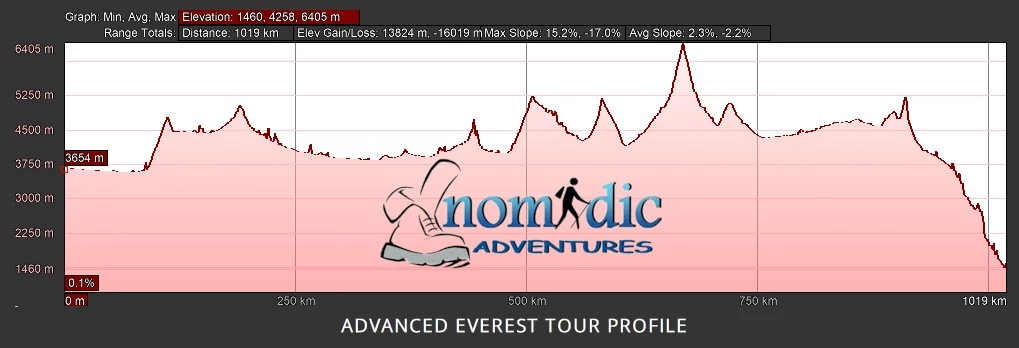
Day-3: Kathmandu to Lhasa (3660m)
Day-4: Lhasa
Day-5: Lhasa
Day-6: Lhasa to Gyantse (3950m)
Day-7: Gyantse (3950m) to Shigatse (3900m)
Day-8: Shigatse to Shegar (4050m)
Day-9: Shegar to Rongbuk (5000m)
Day-10: Rongbuk to Everest Base
Day-11: Everest Base
Day-12: Everest Base to Camp 1
Day-13: Everest Intermediate Camp
Day-14: Rest at Intermediate
Day-15: Everest Camp 2
Day-16: Everest Advanced Base Camp (6340m) and return to camp 2
Camp 3
Day-17: Return to Everest Base
Day-18: Drive Rongbuk - Kirong
Day-19: Drive Kirong - Kathmandu
Day-20: Free at leisure
Day-21: Departure
Day-1: Arrive Kathmandu and transfer to Hotel.
Day-2: Full day Guided sightseeing around Kathmandu valley.

Day-3. Kathmandu to Lhasa (3660m)
Transfer to the airport for the hour-long flight across the main Himalayan range. Afternoon at rest to acclimatise to Lhasa' s high altitude.
Day-4: Lhasa
We will visit Lhasa' s many monasteries and sites, such as the Sera Monastery, and the Norbulingka, the summer palace of the Dalai Lama.
Day-5: Lhasa
We visit the Potala Palace and Drepung Monastery founded in the 14th century, and once the largest in the world, with a population of around 10,000 monks. The afternoon, is a time to relax or further explore the area.
Day-6: Lhasa to Gyantse (3950m)
Travelling by jeep along the Friendship Highway we cross the Khamba La (4794m) and continue westwards over another high pass the Karo La (5045m) with incredible glacial views. We spend the night in a Hotel at Gyantse. [261km]
Day-7: Gyantse to Shigatse (3900m)
After an early morning tour of some of the Gyantse Dzong (14th Century fort) and the Kumbum, a large stupa, we head off on a short 90km drive to Shigatse, the second largest city in Tibet. In the afternoon we will explore the area, local monasteries and market. Overnight at the Hotel. [90km]
Day-8: Shigatse to Shegar (4050m)
We continue along the Friendship Highway, marveling once more at the barren yet spectacular landscape of Tibet. Beyond the town of Lhatse we cross the highest pass on our journey, the Gyamtso La [5220m]. From here we descend to the plains en route to Shegar and overnight at Hotel Quomolongma.[244km]

Day-9: Shegar to Rongbuk
On our travels, we are rewarded with uninterrupted views stretching from Makalu to Shishapangma, with clear views of Everest as we turn into the Rongbuk Valley. Overnight Guest House.(68km)
Day-10: Rongbuk to Everest Base
We spend a night to acclimatise after the 8km trek to Base Camp. Overnight in tents.
Day-11: Base camp of Everest
We will explore the surroundings of the Rongbuk Everest base on short treks and spend time acclimatising. Overnight in tents.
Day-12: Everest Base to Camp 1
We trek alongside the Rongbuk Glacier, an impressive frozen ocean of ice waves. Camp 1 [5460m] is set amongst barren moraine hills and we spend the afternoon acclimatising and doing short treks in the area. (5460m)
Day-13: Intermediate Camp
We trek on the west rim of the glacier as we head to intermediate camp at 5760m. We will also look at the nearby ice seracs which rise like white sails from a debris-laden glacier surface.(5760m)
Day-14: Acclimatisation
We spend time acclimatising.
Day-15: Trek to Camp II
We trek towards the confluence with the Changtse glacier, above which we will find Camp 2 at 5970, set amidst glaciers in the appropriately named Serac Highway. (5970m)
Day-16: Camp II to Advanced Everest Base Camp
Camp 3 is the advanced base camp for the North Col route up Mount Everest. The top of Everest appears phenomenally close now and is as little as some 2400 meter higher than camp 3. Retrace our steps from Advanced Base to Camp 2.
Day-17: Return to base camp
The return to Base is obviously a longer down hill journey from Advanced Base than Camp 2. The decision taken on Day 17 will determine the distance to be covered.
Day-18: Drive Rongbuk to Kirong
After arriving back at Rongbuk, we begin our drive towards Kirong. The return trip goes over the Kirong La (Kirong pass). Because of the earthquake in 2015, the border between Tibet and Nepal is now a little bit more to the west.
Day-19: Kirong to Kathmandu
We arrive at the Chinese - Nepalese border, say goodbye to our Tibetan team, pass through customs and join up with our Nepalese staff. After the crossing of the border we will drive through Dunche and Trisuli in order to reach Kathmandu, a trip which takes about 9 hours, depending on road and weather conditions. [153km]
Day-20: Free at leisure
Day-21: Final departure
End of services